
Strategic Implications for North American Financial Institutions
Note for the Reader: This white paper is written to support informed decision-making by financial institution executives evaluating the strategic implications of fiat-referenced digital assets. Our position is deliberately non-promotional: stablecoins are not introduced here as a replacement for the banking system, but as a modernization layer that can extend the reach, programmability, and velocity of the existing fiat infrastructure. The analysis centers on regulated architectures, risk-managed issuance models, and the role of banks in owning the client experience, the trust layer, and the compliance envelope. Readers should approach this paper as a strategic lens on where programmable money fits into the bank-led modernization journey — not as a speculative object, but as the next evolution of the commercial dollar.
Executive Summary
Stablecoins—digital tokens designed to maintain a stable value relative to a reference asset, typically fiat currency—are reshaping digital finance. Unlike volatile cryptocurrencies, they combine blockchain efficiency with traditional monetary stability, bridging conventional banking and decentralized finance.
For North American banks and credit unions, stablecoins offer
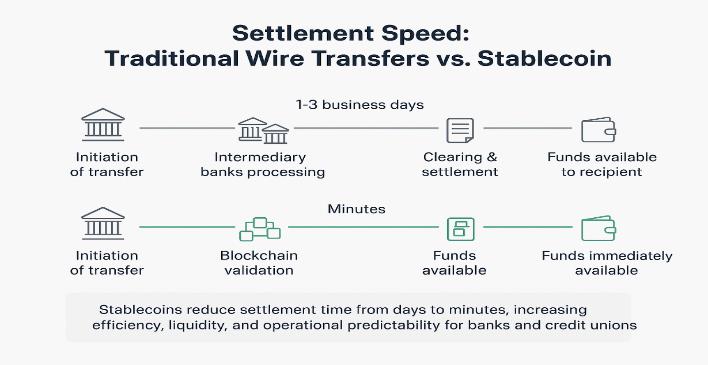
- Operational Efficiency: near-instant settlement, 24/7 liquidity, programmable money.
- Client Engagement: tokenized financial products, digital wallets, and embedded services.
- Strategic Differentiation: competitive positioning in an increasingly digital financial ecosystem.
Risks include regulatory compliance, operational security, and reserve management. U.S. and Canadian regulators are clarifying frameworks, enabling financial institutions to experiment responsibly.
Strategic recommendation: phased adoption integrated into existing regulated frameworks, balancing innovation with risk management.
Introduction
The financial services industry is undergoing rapid transformation due to blockchain, tokenization, and digital assets. Stablecoins have emerged as a core innovation, combining programmable money with stable value.
Market trends (Feb 2024 – Feb 2025):
- Active stablecoin addresses rose ~53% to 30M+.
- Total supply increased ~63% to ~$225B.
- Monthly transfer volumes more than doubled to ~$4.1T.
For banks and credit unions, these developments represent both opportunity and challenge:
- Opportunities: real-time payments, tokenized deposits, automated treasury functions.
- Challenges: integrating DeFi concepts into regulated operations, adapting legacy systems.
Regulatory clarity in the U.S. and Canada supports safe experimentation while mitigating risk. Stablecoins, strategically deployed, can catalyze modernization, operational efficiency, and enhanced client offerings.
Definition & Typology of Stablecoins
Stablecoins are digital assets pegged to a reference asset (most commonly USD or CAD). They enable faster settlement, liquidity optimization, and innovative client products.
Key categories and strategic relevance:
TYPE
Fiat-Collateralized
Crypto-Collateralized
Algorithmic
Hybrid
MECHANISM
Backed 1:1 by fiat (USDC, USDT)
Backed by crypto, often overcollateralized (DAI)
Supply adjusted via code (FRAX)
Combines fiat, crypto, algorithmic
STRATEGIC RELEVANCE
Tokenized deposits, real-time settlement, cross-border transactions
Decentralized alternatives, programmable features, risk management needed
High scalability, flexible, higher risk, cautious adoption recommended
Customizable programmable financial products, risk mitigation
Enabling technologies:
- Smart Contracts: Automate settlement, redemption, and compliance triggers.
- Asset Tokenization: Digitizes deposits, securities, collateral; facilitates liquidity and operational efficiency.
Historical Evolution of Stablecoins
- Early experiments (2014–2017): BitUSD, NuBits – highlighted need for transparent collateralization.
- Fiat-backed adoption (2017–2020): USDT, USDC – reliable, scalable, triggered institutional interest.
- Regulatory attention (2020–2022): U.S. OCC/FinCEN guidance, Bank of Canada CBDC exploration.
- Algorithmic failures (2022–2023): underscored governance and stability risks.
- Current trends (2023–2025): Institutional pilots (JPM Coin, USDF), cross-border payments, programmable money adoption.
- Key lesson: transparency, collateral, governance, and regulatory compliance are essential for safe integration.
Use Cases
- Payments & Remittances: Near-instant, low-fee domestic and cross-border transactions.
- Decentralized Finance (DeFi): Medium of exchange, collateral, liquidity provider.
- Treasury & Hedging: Portfolio stability, corporate liquidity management.
- E-commerce & Retail: Digital payments without crypto volatility.
- CBDCs & Regulatory Experimentation: Interoperable with central bank digital initiatives.
CEO Insight: stablecoins bridge traditional banking and blockchain innovation, offering practical applications across payment, treasury, and client services.
Strategic Value Proposition
1. Operational Efficiency
– Instant settlement, reduced intermediary fees, enhanced liquidity management.
2. Client Services & Revenue Streams
– Digital wallets, cross-border payments, regulated DeFi access.
3. Competitive Differentiation
– Attract digital-native customers, fintech partnerships, tech-forward brand positioning.
4. Risk & Compliance
– Price stability, regulated issuers, operational transparency.
5. Strategic Considerations
– Which stablecoins meet regulatory and reputational standards?
– How to integrate with existing infrastructure and fintech partnerships?
– Client education and trust-building strategies.
Executive summary: Stablecoins are a strategic lever for efficiency, revenue diversification, and competitive positioning.
Risk & Compliance Overview
Operational/technological: Smart contract bugs, cybersecurity threats, reserve management. Financial/market: Peg stability, counterparty risk, settlement/FX exposure.
Regulatory: AML/KYC compliance, consumer protection, licensing requirements, evolving frameworks.
Mitigation strategies:
• Governance & oversight policies.
• Secure custody & multi-layer security.
• Continuous compliance monitoring.
• Proactive engagement with regulators.
• Stress testing & contingency planning.
Key takeaway: Robust frameworks enable safe adoption while maintaining trust and credibility.
Implementation Pathways
1. Strategic Planning & Assessment
• Identify high-value use cases, align stakeholders, perform cost-benefit analysis.
2. Technology Integration
• Wallet infrastructure, payments/settlement integration, interoperability.
3. Risk & Compliance Integration
• Align with AML/KYC, operational controls, liquidity management.
4. Phased Adoption
• Pilot → Scale → Full Integration, iterative learning, performance evaluation.
5. Partnerships & Ecosystem Participation
• Regulated stablecoin issuers, blockchain providers, industry consortia.
Key Takeaway: structured, phased adoption maximizes benefits while minimizing risk.
Conclusion & Future Outlook
Strategic imperative: Stablecoins are more than payment tools—they accelerate settlement, enhance customer experience, and strengthen competitive positioning.
Risk-conscious adoption: Anchored in governance, compliance, and operational resilience.
Implementation as a pathway:An Iterative pilot-to-full integration approach ensures learning and alignment with institutional goals.
Looking ahead: Early adoption positions institutions for leadership in the digital financial ecosystem.
Final thought: Stablecoins offer a bridge between traditional banking and digital assets—strategic, secure, and compliant integration is a leadership opportunity.
Key Takeaways: Stablecoins for Financial Institutions

PILLAR
Strategic Value
Risk & Compliance
Implementation Pathways
Future Outlook
INSIGHT
Accelerates settlement, enhances client experience, strengthens competitiveness
Integrate AML/KYC, mitigate operational/financial risks, maintain trust
Pilot programs → scale → full adoption; leverage interoperability
Appendices (Summarized)
A. Glossary (selected terms): Stablecoin, Fiat-backed, Crypto-backed, Algorithmic, Tokenization, Smart Contract, CBDC, Custody, KYC/AML.
B. Major Stablecoins (2025 snapshot): USDT, USDC, DAI, PYUSD, FDUSD, EUROC, USDS – with issuer, collateral type, peg, regulatory notes.
C. Regulatory Guidance: U.S. (FinCEN, OCC, SEC, CFTC), Canada (OSFI, Bank of Canada), EU (MiCA), FATF – high-level compliance frameworks summarized.
Note: Full tables and detailed guidance available in annex/reference material.
References:
Bank of Canada (2024). Retail Payments Modernization: Digital Forms of Money.
Board of Governors of the Federal Reserve System (2024). Money and Payments: The U.S. Dollar in the Age of Digital Transformation.
BIS Committee on Payments and Market Infrastructures (2024). Future of Cross-Border Payments: 2030 Priority Map.
Financial Stability Board (2024). High-Level Recommendations for Global Stablecoin Arrangements: Implementation Progress.
OCC (Office of the Comptroller of the Currency) (2023). Interpretive Letters on Digital Asset Activities for Federally Chartered Banks.
FinCEN (2024). AML/CFT Guidance for Convertible Virtual Currency and Stablecoin Issuers.
OSFI (Canada) (2024). Digital Innovation Roadmap: Deposit Token Exploration Themes.
IMF (2024). Tokenization, Deposit Tokens, and the Emerging Digital Money Stack.
JP Morgan Onyx (2024). Deposit Tokens and Enterprise Blockchain Settlement: Lessons From Pilot Programs.
Circle (2025). USDC: Institutional Risk and Controls Framework.
Visa (2024). Programmable Payments and Smart Contract Settlement Infrastructure.

SIMON VINCENT
Calgary, Canada
Simon is the co-founder and CEO of Acclaro Consulting Solutions, advising executive teams in the global technology sector on strategy and business development. With more than 40 years of leadership experience across telecom, energy, and fintech, he brings deep industry insight and a strong record of guiding organizations through growth and change. He holds an MBA from the University of Calgary, a BA (Hons) from Queen’s University, and multiple executive and team coaching certifications. Simon has also served in key community roles, including Chair of the Calgary Chamber of Commerce and board positions with Innovate Calgary, JDRF, CMHA, and Canadian Hearing Services.