
Appendix A: Practical Steps to Fit Scale and Resources
Smaller banks may lack the scale of larger institutions, yet they possess agility and a personal approach. Success hinges on deliberate action—prioritizing pivotal areas, fostering experiential growth, and embedding succession as a central element of strategic planning.
Right-Sized Succession Planning: Ten effective Approaches for Sustainable Leadership
- Initiate with Clarity and Purpose
The CEO should designate a senior leader(s), commonly the CHRO or jointly with the COO, to oversee the succession planning process and ensure that senior management is fully engaged to deliver consistent, unbiased talent development and evaluation. Incentive plans should be designed to motivate this behavior.
- Prioritize Key Roles
Identify critical positions whose absence would significantly affect operations, compliance, or strategic objectives. Develop the succession plan with an initial emphasis on these core management roles—think not just customary executive management roles but other roles such as the CTO or CISO(or a position with these responsibilities).
- Schedule Regular Talent Reviews
Hold annual or semiannual reviews among executives and board members to assess leadership readiness, identify developmental needs, and address emerging talent gaps. Talent profiles and a matrix showing KMPs, interim successors and candidates identified in readiness categories are appropriate tools for this exercise.
- Utilize Board Expertise and Banking Associations
Engage board members as mentors and advisors. Take advantage of state and national banking associations to facilitate learning and development opportunities through workshops and seminars.
- Advance Leadership Through Experiential Learning
Offer cross-training, temporary projects, shadowing, or stretch assignments to KMP candidates. Experiential development is both practical and impactful.
- Selectively Engage External Advisors
Periodically seek input from external peer CEO’s like The NBS Group CEO Exchange consultants or executive recruiters, to evaluate succession processes, validate readiness assessments, and provide unbiased feedback.
- Implement a Succession Dashboard
Employ Leadership Assessments, the 9 Box, Development Plans, Talent Profile to monitor successor readiness and development initiatives. Note: Leadership Assessments can be costly, especially when done by an outside consultant (industrial psychologist), although there are less costly alternatives that involve a combination of internal HR capabilities, boutique consulting, executive recruiters and/or resources provided by state and national banking associations.
- Integrate Succession into Strategic Discussions
Include succession updates in regular management and board meetings, positioning it as a forward-thinking strategic priority rather than solely a regulatory obligation.
- Align Succession Planning with Organizational Strategy
Ensure leadership development priorities adapt alongside the bank’s strategic direction, targeting skills sets that will drive success, such as in digital acumen, cybersecurity, AI and data analytics, as examples.
- Commence CEO Succession Planning Well in Advance
Begin planning for CEO succession at least three years prior to any anticipated transition, identifying both interim and long-term successors to safeguard continuity and preparedness. CEOs should be forthright with their boards regarding their planned departure so the transition process can be managed most effectively.
Alignment Note: How Appendix B, C and D Work Together
The Leadership Assessment, 9 Box, and Talent Profile are designed to work in tandem within the succession planning process.
- The Leadership Assessment evaluates an individual’s capabilities, leadership style, key developmental needs, and potential readiness for greater responsibilities.
- The 9 Box Matrix is a comparative talent management tool that plots employees on two dimensions—Performance (what they deliver) and Potential (their ability to grow into bigger or more complex roles). Gives an organizational picture of the gaps and strengths in skills and leadership.
- The Talent Profile provides a holistic record of career history, skills, and aspirations, offering a factual foundation for succession discussions.
Together, these tools ensure that succession planning decisions are balanced, evidence-based, and actionable. The Leadership Assessment highlights who the leader can become, and what experiences are needed to get there, the assessment informs the 9 Box, while the Talent Profile grounds that insight into who the leader is today, and what their record is so far. This alignment allows for more accurate readiness classifications and targeted development planning.
Appendix B: Leadership Assessment
A leadership assessment is a structured evaluation used to gauge an individual’s leadership potential and capabilities. It helps organizations identify strengths and areas for development in current and aspiring leaders, guiding decisions related to hiring, promotion, and leadership development programs. These assessments can involve various tools like in-depth behavioral interviews, personality tests, 360 feedback processes, skill inventories, and scenario-based evaluations.
Assessment should be conducted by internal HR professional who has the skills and experience or a qualified outside consultant.
What it assesses:
Leadership Skills:
- Evaluates abilities like decision-making, strategic thinking, communication, people leadership, and the ability to lead and navigate change.
- Examines personality characteristics relevant to leadership, such as emotional intelligence, integrity, resilience, and self-awareness.
- Assesses how an individual is likely to behave in leadership situations.
- Helps determine whether someone is suited for a leadership role and their readiness for advancement, as well as their ‘coachability’ and how they respond to feedback.
How it’s used:
- To select candidates for leadership positions and identify high-potential individuals for promotion.
- To prepare for future leadership needs and ensure a smooth transition when leaders retire or leave.
- To create tailored training and development plans for leaders, focusing on areas where they need to improve.
- To understand the overall leadership effectiveness within an organization and identify areas for systemic improvement.
Types of assessments:
- These assess personality traits, cognitive abilities, and behavioral patterns.
- Collects feedback from multiple sources, including peers, subordinates, and superiors.
- Present hypothetical situations to evaluate how an individual would respond in a leadership role.
- Measure an individual’s proficiency in specific leadership skills.
In essence, leadership assessments provide valuable insights into an individual’s leadership capabilities, helping organizations make informed decisions about talent management and leadership development.
Appendix B: Example Leadership Assessment
Candidate Name: Sarah Jones
Current Role: SVP, Retail Banking
Assessment Date: September 2025
Assessor: Internal HR professional or Independent Consultant
- Leadership Skills
-
-
- Decision-Making: Strong—demonstrated quick, sound judgment in crisis situations.
- Strategic Thinking: Emerging—needs broader exposure to enterprise-level planning.
- Communication: Excellent—articulate and trusted by staff across levels.
- People Leadership: Proven ability to build cohesive branch teams; scored in top quartile on 360 feedback.
-
- Personality Traits
-
-
- Emotional Intelligence: High—empathetic and perceptive.
- Integrity: Strong record of ethical decisions.
- Resilience: Handles setbacks constructively; maintains composure under pressure.
-
- Behavioral Tendencies
-
-
- Collaborative Style: Works well cross-functionally, though hesitant to delegate strategic tasks.
- Innovation Orientation: Conservative; benefits from encouragement to take calculated risks.
-
- Leadership Potential
-
-
- Readiness: 1–3 Years Out for COO or Head of Retail.
- Key Development Needs: Greater exposure to enterprise-wide budgeting; project leadership in digital transformation.
-
Overall Assessment:
Sarah has strong people leadership and communication skills. With targeted development, particularly in strategic and digital areas, she is well-positioned for executive advancement.
Appendix C: Understanding the 9-Box Talent Matrix
The 9-Box Talent Matrix is one of the most widely used tools for evaluating leadership potential and performance.
By plotting individuals into one of nine boxes, leaders can more easily align development actions, succession planning, and resource investment with organizational priorities.
The 9-Box Framework
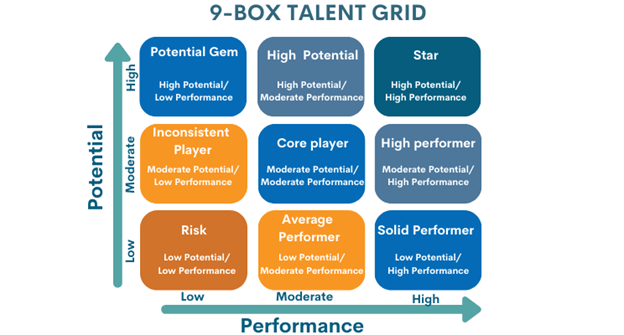
Dimensions Explained:
- Performance (Vertical Axis): Measures how consistently the employee meets or exceeds goals, demonstrates core values, and delivers results.
- Potential (Horizontal Axis): Evaluates capability for greater responsibility, learning agility, leadership behaviors, and ability to adapt to change.
Each “box” suggests a different development or management approach.
How the 9-Box Supports Succession Planning
- Identifies Leadership Bench Strength – Clarifies who is ready now, who could be ready soon, and where gaps exist.
- Prioritizes Development Investment – Helps direct resources toward high-potential employees.
- Facilitates Honest Conversations – Promotes shared understanding among executives of talent readiness and gaps across the organization.
- Links to the Readiness Framework – Complements your “Ready Now / 1-3 Years / 3-5 Years / 5+ Years” readiness model.
- Integrates with Leadership Assessments and Talent Profiles – The matrix helps visualize assessment results and profiles collectively during annual reviews.
Example: Using the 9-Box in a Community Bank
During an annual talent review, a community bank’s executive team evaluates 12 senior managers using the 9-Box. Each manager’s Leadership Assessment (Appendix A) and Talent Profile (Appendix B) inform their placement.
- Example Placement:
- Maria Lopez, SVP of Commercial Lending, is rated High Performance / High Potential. She consistently exceeds growth targets and demonstrates strategic thinking and people leadership. She is identified as a High-Potential Leader (top-right box) and included in the 1–3 Years Ready pool for the Chief Commercial Banking Officer role.
- David Kim, VP of Operations, shows Moderate Performance / High Potential. While strong in process improvement, he needs broader exposure to customer-facing activities. He is placed as an Emerging Leader, with a development plan that includes a rotational project in Retail Banking.
- Sarah Jones, SVP of Retail Banking (from your Appendix A example), might be positioned in High Performance / Moderate Potential—a Key Performer—critical to stability and culture, though less likely to move into a C-suite role.
At year-end, the matrix helps the executive team visualize its leadership bench, determine where to focus development, and communicate a clear succession strategy to the board.
CEO Insight
The 9-Box helps you move from subjective impressions to objective, evidence-based talent conversations. It’s not about labeling people—it’s about planning how to grow them.
Appendix D: Talent Profile
A talent profile is a comprehensive document that summarizes an individual’s skills, experience, and qualifications, often used by organizations to identify, assess, and develop their workforce. It provides a holistic view of an employee’s capabilities and potential, aiding in career development, succession planning, and talent acquisition.
Talent profiles are aligned with a leadership assessment in that the development plan actions created from the assessment are incorporated into a candidate’s profile, as is the development plan progress. Additionally, a profile is a concise document for review with the board and executive management.
Key Components of a Talent Profile:
- Work History: Past roles, responsibilities, and accomplishments.
- Education and Certifications: Degrees, diplomas, and professional certifications.
- Skills: Technical and soft skills relevant to current and potential roles.
- Career Interests and Goals: A person’s aspirations and desired career paths within the organization.
- Performance Data: Past performance reviews, 360-degree feedback, and other performance indicators.
- Potential and Readiness: Assessments of future potential and readiness for new roles or responsibilities.
- Other Professional Qualifications: Professional affiliations, licenses, and any other relevant qualifications.
Uses of Talent Profiles:
- Internal Mobility: Matching employees with suitable opportunities based on their skills and career goals.
- Succession Planning: Identifying high-potential individuals for future leadership positions.
- Targeted Development: Providing tailored training and development opportunities based on individual needs and aspirations.
- Performance Management: Using performance data to assess strengths and areas for development.
- Recruitment: Identifying potential candidates for open positions based on specific skill sets.
Benefits of Talent Profiles:
- Improved Decision-Making: More informed decisions about talent development, deployment, and recruitment.
- Increased Employee Engagement: By providing opportunities for growth and development, employees are more likely to feel valued and engaged.
- Enhanced Organizational Performance: By optimizing talent management practices, organizations can improve overall performance.
- Better Resource Allocation: Optimizing the allocation of resources for training and development.
- Increased Transparency: Making talent information more accessible and transparent within the organization.
Appendix D: Talent Profile Template
Candidate Name: ______________________________
Current Role: ______________________________
Date Completed: ______________________________
Work History
- [List of roles, organizations, and key responsibilities]
Education & Certifications
- [Degrees, diplomas, certifications]
Skills
- Technical Skills: ____________________________
- Soft Skills: ______________________________
Career Interests & Goals
- [Describe desired career path, leadership aspirations, functional interests]
Performance Data
- [Summaries of performance reviews, key metrics, or 360 feedback]
Potential & Readiness
- [Readiness tier: Ready Now, 1–3 Years, 3–5 Years, 5+ Years]
- [Strengths and development needs]
Other Professional Qualifications
- [Memberships, licenses, board participation]
Reviewer/Manager: ________________________________
Next Review Date: ________________________________

WAYNE F. PATENAUDE, CFA
Boston, Massachusetts
Wayne is a financial services executive and board director with 30+ years of leadership in banking and strategic finance. As President and CEO of Cambridge Financial Group and Cambridge Savings Bank, a $7B institution, he drove three strategic plans delivering 21% annual earnings growth over more than a decade. He launched Ivy Bank, which secured $850M in deposits, led a community bank acquisition, and built an Asset-Based Lending division exceeding $200M. Wayne has served on nonprofit and civic boards including the Cambridge Chamber of Commerce and the American Red Cross, with a strong focus on governance, leadership, and community impact.